watsonx Workshop Context Manager
An AI-assisted content management platform for seller enablement
My Role
Tools & Tech
watsonx Workshop provides up-to-date product details, roleplay practice scenarios, and on-the-go learning content to the global IBM salesforce. This data is graded, enriched and curated with Context Manager.
As the entry point for all product and software data used by Workshop's AI agents, Context Manager gives product owners the tools to load, organize, and even create product documentation across IBM's entire product catalog. Leveraging AI-assisted content generation tools, product teams can create new or enhance existing content before making it available in Workshop.
Creating the experience for content managers to curate and enrich product context for AI-assisted enablement
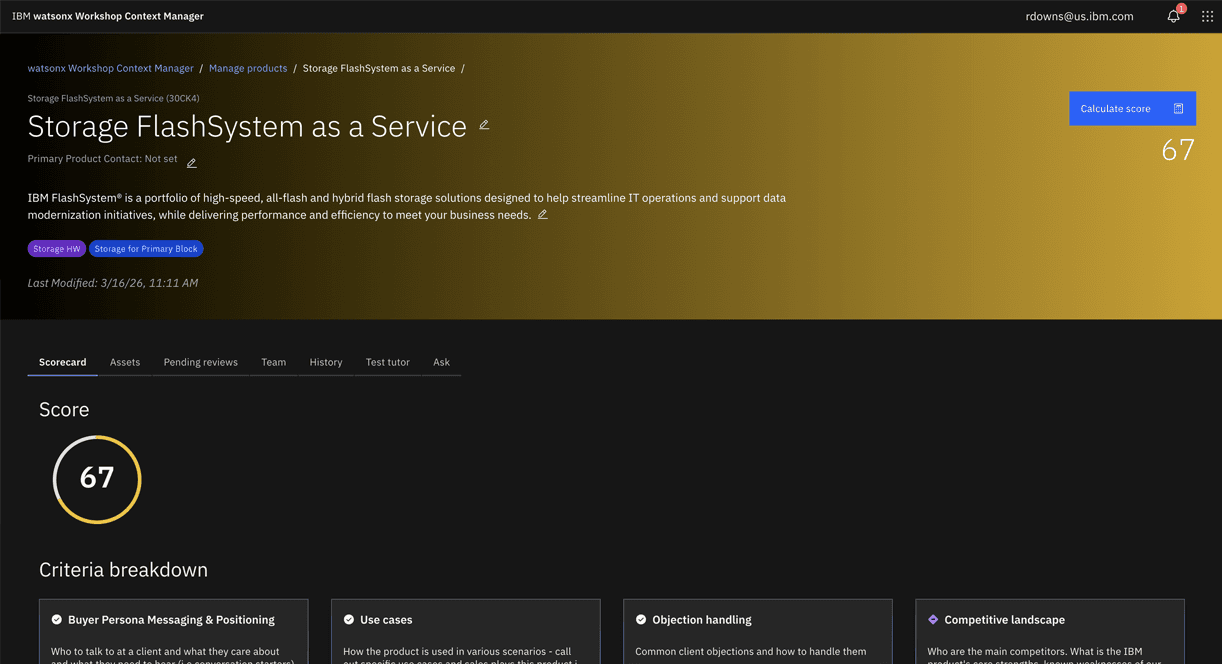
Product homepage shows users the overall quality score of a product's context, breaking down feedback by key criteria.
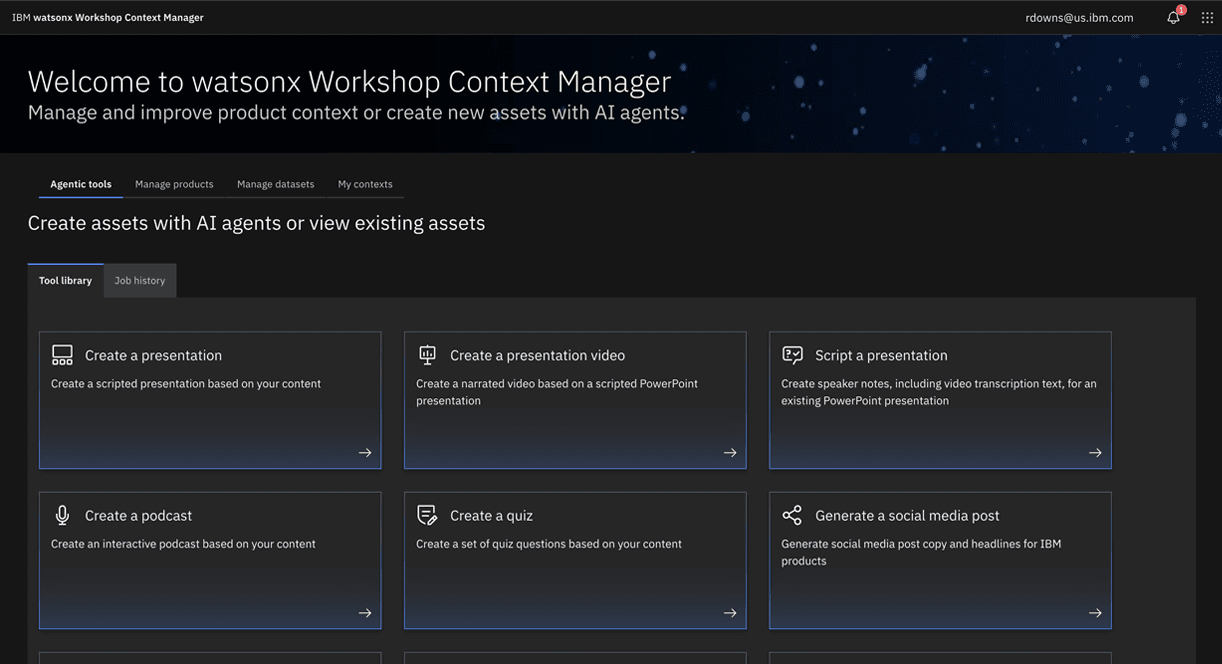
Clear and simple user interface for content managers to create or enhance product assets to be uploaded to a product's overall context
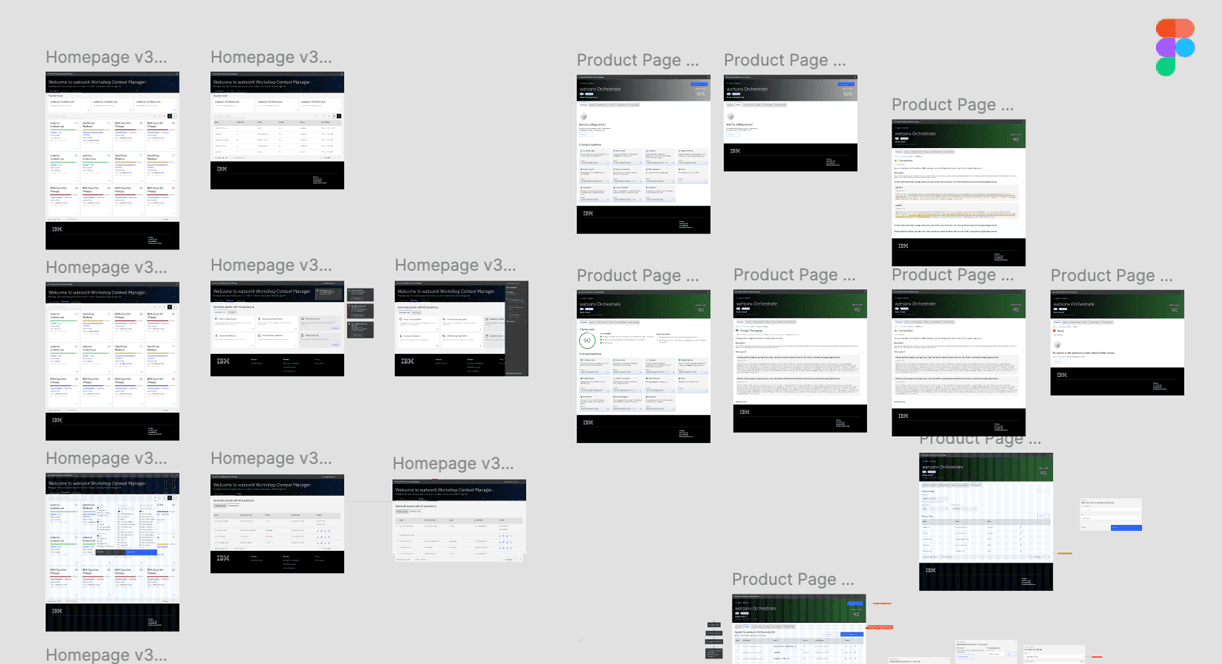
Owned the Context Manager Figma file, showcasing IBM Carbon and custom components, user flows, and screen states organized and ready for dev implementation
Problem
AI has become central to modernizing sales enablement at IBM and across the industry. watsonx Workshop, IBM's AI-assisted sales enablement platform, needed a reliable, scalable source of truth to ground its accuracy across hundreds of IBM products. Without a structured way to ingest and manage content across hundreds of products, gaps and outdated information adversely affect the quality and accuracy of Workshop's AI-generated outputs, and therefore the effectiveness of sales teams.
Solution
Context Manager gives product owners and content managers a dedicated workspace to upload documents by product, with each upload enriching the context that Workshop draws from. The platform also includes AI-assisted tools to enhance or create completely new documents. For example, uploading a PowerPoint with no speaker notes automatically triggers AI generation of notes for each slide, improving content quality before a product owner adds it to the product's context.
Key contributions
UX & UI Design + Accessibility
Designed wireframes and high fidelity prototypes of the end-to-end user experience for Context Manager from the ground up, establishing the information architecture, interaction patterns, and visual language with accessibility supported throughout by the Carbon Design System, built to meet WCAG 2.1 AA standards
Frontend
Development
Responsible for the React frontend as one of three founding engineers who brought the application from zero to launch, and have remained a core team member driving feature development, mentorship, and UI improvements across the platform
AI-Assisted Content Enhancement Tools
Developed interfaces for AI-assisted content generation features, enabling users to enhance raw documents before contributing to product context
Document Ingestion Pipeline UI
Designed and built the document management experience, giving teams a clear, structured workflow for uploading and organizing content and clear visuals to identify gaps in quality
Outcomes
As Context Manager's UI and design lead, I created the platform's foundational interface and implemented its core component architecture, now used by a team of over 30 developers.
Business
- Complete IBM product catalog is managed via Context Manager for sales enablement curation and education
- 100+ product owners empowered to actively manage and enrich product context for use in other AI tools within the IBM sales enablement ecosystem
- Reduced dependency on manual content curation through AI-assisted generation tools
- Directly improves the accuracy and depth of AI outputs across the watsonx Workshop platform
Technical
- Founding design engineer responsible for UI design and frontend implementation of the platform from inception to launch
- Designed scalable UI patterns to support a large, distributed team of content contributors and developers
- Full-stack collaboration across React, Ruby, and Python with a PostgreSQL-backed architecture
- AI-assisted generation workflows integrated into the document ingestion experience